
Consistent chili oil depends on much more than selecting the right peppers or oil. Flavor development, thermal treatment, particle distribution, filling accuracy, and package integrity all influence the final product, making production control an important consideration for any chili oil manufacturer. JOLION Foods operates as an OEM/ODM food manufacturer, with production capabilities that connect ingredient processing, thermal treatment, and automated packaging within a broader manufacturing workflow.
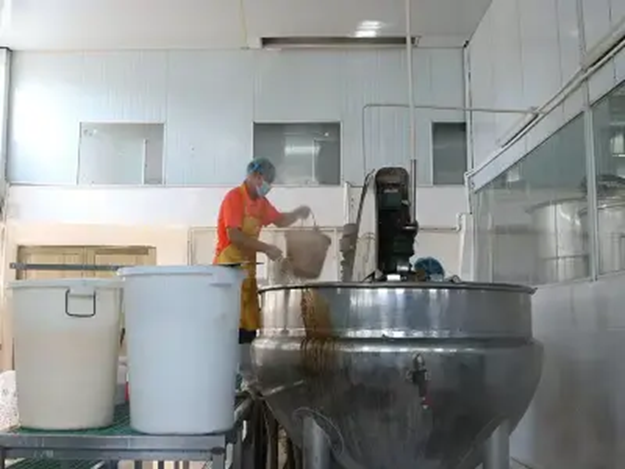
Preparing Ingredients for Consistent Flavor
Raw material preparation sets the foundation for chili oil quality. Dried or fresh peppers can differ in moisture, pungency, color, and particle structure, so incoming materials need to be assessed before entering the main process. Variations at this stage can later appear as differences in aroma intensity, color, sediment, or perceived heat.
Fermentation may be incorporated into certain chili-based formulations to develop deeper aromatic and savory characteristics. A fermentation tank provides a controlled environment in which temperature, time, ingredient proportions, and sanitation conditions can be managed more consistently than an uncontrolled process. The required fermentation profile depends on the recipe and desired sensory characteristics.
Particle preparation also deserves attention. Pepper flakes, powders, and other ingredients interact differently with heated oil. Larger particles can create a more pronounced texture, while finer material disperses more readily. The target particle size should match the intended product style rather than being determined solely by processing convenience.
Oil-phase preparation also affects how consistently flavor is extracted from the prepared ingredients. Heating temperature, infusion time, and agitation conditions influence the release of color, aroma, and capsaicin into the oil. Controlled process parameters help reduce batch-to-batch variation without changing the intended recipe.
Managing Thermal Processing and Oil Interaction
Heat plays several roles in chili oil production. It can extract desirable compounds from chili ingredients, develop roasted or toasted notes, and influence the final aroma profile. Excessive thermal exposure, however, may produce burnt flavors or degrade delicate aromatic compounds, making temperature control an important part of recipe development.
A stewing line can provide controlled heating and mixing during this stage. Rather than relying on a single high-temperature treatment, manufacturers can establish defined heating profiles according to ingredient composition, batch size, and desired flavor development. Agitation also helps distribute solids and heat throughout the mixture.
Oil viscosity changes with temperature, which affects mixing and transfer behaviour. A formulation that flows readily during hot processing may behave differently during cooling and filling. Production planning consequently needs to connect thermal parameters with downstream pumping, filtration, storage, and packaging conditions.
Improving Packaging Consistency
Packaging is closely tied to product stability and consumer convenience. Oxygen exposure, light, closure quality, and filling accuracy can all influence the condition of an oil-based chili product during storage. Package selection should reflect the intended shelf life, distribution environment, and serving format.
A full-automatic mantle thermal shrinker can be used within packaging operations where shrinkable materials are part of the final package configuration. Controlled heat application helps form the packaging material around the designated area without relying entirely on manual handling. Temperature and dwell time still need to be matched with the packaging material to avoid deformation or poor adhesion.
The final filling stage also requires precise control. A full-automatic packing machine can coordinate filling and packaging operations at a consistent production rhythm, reducing variation caused by manual intervention. Accurate portion control becomes particularly relevant when products are supplied in multiple retail sizes or when contract manufacturing requires repeatable specifications across production batches.
Post-filling inspection also contributes to packaging consistency. Seal integrity checks, fill-weight verification, and routine sampling help identify deviations before a batch reaches distribution, particularly when multiple package sizes run on the same line.
Building a Scalable Manufacturing Workflow
Equipment selection becomes more meaningful when the entire production sequence is considered as one system. Fermentation, stewing, transfer, filling, sealing, and outer-package treatment each influence the next stage. Poor coordination between otherwise capable machines can create bottlenecks, excessive holding time, or inconsistent product conditions.
Automation can also improve process traceability. Defined temperature settings, processing times, filling parameters, and equipment conditions create measurable production points that can be monitored and documented. Such records are useful when a product needs to be reproduced across multiple batches or customized for different customers.
JOLION Foods uses a combination of fermentation, thermal processing, shrink packaging, and automatic packing machinery within its food production capabilities. For a chili oil manufacturer, this type of equipment integration provides a framework for handling different recipes and package formats while keeping the manufacturing sequence organized around defined process parameters.
Conclusion
Chili oil production combines culinary formulation with controlled industrial processing. Ingredient condition influences the starting profile, thermal treatment shapes flavor development, and packaging equipment determines how consistently the finished product reaches its intended format.
JOLION Foods connects these stages through OEM/ODM manufacturing capabilities, while a chili oil manufacturer can evaluate machinery according to recipe complexity, batch scale, thermal requirements, and packaging specifications rather than viewing each machine as an isolated investment.
