
A single purchase figure says little about the equipment behind it. Anatomy-table systems combine a large interactive display, computing hardware, specialized software, and reconstructed anatomical data, while installation may also need to be considered during procurement. Differences in physical format and data detail can therefore produce substantial differences in cost even when two products share the same general name. Price becomes easier to interpret when the quotation is separated into the technical elements that shape how the system will be used.
Why Physical Size Changes the Quotation
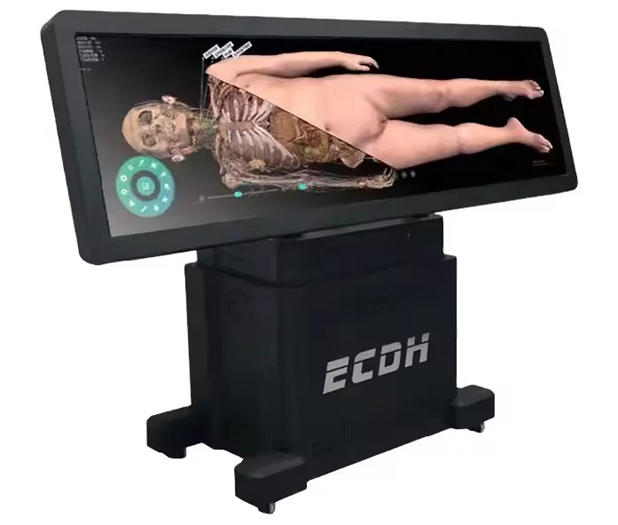
Display dimensions influence both teaching capacity and engineering requirements. A virtual anatomy table price may rise with system size because a larger unit requires more display area, a supporting structure, suitable touch hardware, and enough computing performance to maintain responsive interaction.
Size also changes the learning setting. A compact unit may be practical for individual review or a small group, while a larger surface can allow several learners to gather around the same anatomical view. Room layout, access routes, electrical supply, and instructor movement all affect whether additional size produces useful teaching value.
The most expensive physical format is not automatically the best match. A laboratory that emphasizes group demonstration has different needs from a room designed for rotating independent stations. The relevant question is how much usable viewing and interaction space the planned class requires.
Viewing distance and group position also matter. A broad display may improve visibility for learners standing around the table, but it can occupy circulation space or require a different room arrangement. Physical dimensions become a price factor because they affect the complete teaching station, not merely the diagonal measurement of a screen.
Resolution Begins With the Source Data
An anatomical model cannot display detail that is absent from its underlying dataset. DIGIHUMAN’s published description identifies 17,571 male cross-sections and 16,141 female cross-sections, each associated with a 0.1 mm layer thickness. Closely spaced sections provide a dense basis for reconstructing small boundaries and continuous structures.
Higher source resolution affects more than image sharpness. Fine spacing can preserve the continuity of vessels, nerves, and tissue edges when sectional data is assembled into a three-dimensional body. It may also increase storage, processing, and graphics demands because more information must be managed during rotation, zooming, and sectional exploration.
Layer thickness is one part of resolution rather than a complete measure of model quality. Segmentation, reconstruction, labeling, and display performance determine whether the source detail remains useful after the sectional images become an interactive body. A specification is most informative when these stages are considered together.
Resolution should therefore be considered in relation to the curriculum. Large organs and basic orientation may not demand the same level of detail as sectional anatomy, neuroanatomy, or demonstrations involving small branches. Data density has value when the teaching activity can use the anatomical information it preserves.
Touch Interaction Is Part of the System
The virtual anatomy table price also reflects the difference between viewing a model and manipulating it in real time. A touch interface must translate gestures into smooth changes in scale, orientation, layer visibility, or cutting plane. Delay, inaccurate touch response, or interrupted rendering can weaken the connection between a learner’s action and the anatomical result.
The DIGIHUMAN system described in the pricing material supports real-time interaction with the three-dimensional body model. That capability joins the display, processor, software, and anatomical content into one operating platform. It is not simply an accessory placed over a conventional screen.
Interactive functions also shape classroom management. An instructor may prepare a view, rotate the body during explanation, isolate a structure, and restore the previous state. Repetition is especially important when several groups need to begin from comparable anatomical conditions.
Interpreting the USD 30,000 to USD 80,000 Range
The cited approximate range of USD 30,000 to USD 80,000 covers more than one model or size. As a result, the endpoints should not be treated as a universal low and high price for every installation. The actual quotation depends on the selected model and size.
Useful comparisons keep like items together. Display size should be compared with display size, data and software scope with equivalent content, and included installation or support with the same service categories. Otherwise, a lower initial figure may represent a narrower system rather than a less costly version of identical equipment.
A quotation can also separate acquisition from continuing operation. Institutions may need to account for staff preparation, maintenance arrangements, software updates, room use, and local technical support. These factors do not change the published equipment range, but they influence the complete cost of operating the teaching resource.
Matching Cost to the Intended Teaching Role
Price evaluation begins with the lesson, not with the top specification. A department can define the expected number of simultaneous users, required anatomical detail, frequency of use, available room space, and interactive tasks before comparing models. Those conditions give each feature a practical reason for being included.
For DIGIHUMAN, model and physical size are stated variables behind the quoted range, while dense tomographic data and touch interaction describe part of what the system contains. The final virtual anatomy table price therefore depends on the selected model and size rather than a single fixed price for the entire product category.
The soundest reading of a quotation is functional: the selected system should provide the display scale, data resolution, and responsiveness required by its planned classes. Cost becomes meaningful only after those requirements have been defined.
